Preparation Characterization and Applications Ofliposomes State of the Art
Encapsulation of food agile ingredients in liposomes
Padilla Camberos Eduardo, Villanueva Fernando Jesus Emmanuel
Medical and Pharmaceutical Biotechnology, Heart for Research and Practical Engineering in Jalisco, Mexico
Correspondence: Padilla Camberos Eduardo, Medical and Pharmaceutical Biotechnology, Center for Research and Applied Technology in Jalisco, ciatej, Normalistas 800, Guadalajara, Jalisco, United mexican states, Tel 3333455200
Received: April 18, 2018 | Published: May eleven, 2018
Citation: Eduardo PC, Emmanuel VFJ. Encapsulation of food agile ingredients in liposomes. J Nutr Health Nutrient Eng. 2018;8(3):238-239. DOI: 10.15406/jnhfe.2018.08.00276
Download PDF
Liposomes are microscopic vesicles equanimous of phospholipid bilayers entrapping one or more aqueous compartments. Their backdrop accept permitted numerous applications in several fields, including the food industry. The controlled release of active ingredients can exist achieved using liposomes. In this mini-review we briefly innovate diverse aspects of liposomes preparation and their application in food technology.
Liposomes are colloidal aggregates formed past ane or more closed bilayers, which include in their interior a pocket-size fraction of the aqueous medium.1 They grade spontaneously when the lipid molecules (mostly phospholipids) generate the membrane that encloses an active amanuensis, and are dispersed in the aqueous medium giving rise to suspensions of vesicles with diameters that can take a size from nanometers to microns (Figure 1).2 Liposomes have item characteristics and take been studied in many fields as medical, environmental and food, some studies are based in models of cell membranes helping to elucidate the physical and chemical beliefs, organization of cell compartments and the structures of cell ship.iii
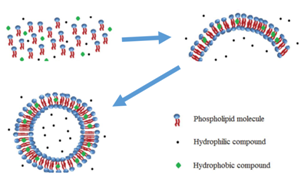
Effigy one Liposome germination. modified from Emami et al.12
Liposomes are classified according their structure, taking account the blazon of layers formed at the moment of producing the membranes of the vesicles. They environment the agile medium that is intended to be encapsulated and the size they have at the end of the encapsulation.4
- Big multilamellar vesicles (LMV): Formed past multiple concentric bilayers separated by an aqueous infinite of approximately 5nm in thickness.
- Large unilamellar vesicles (LUV): Presents a single lipid chimera and the size ranging from 50 to 300nm.
- Small unilamellar vesicles (SUV): Measure oscillates from 25 to 50nm of bore. Due to their size they accept a very narrow radius of curvature that makes the lipids tend somewhere more in the outer half than in the inner half of the room.
At that place are different methods for obtaining liposomes, by example
- Method of hydration of the film: when phospholipids and membrane components are dissolved in a volatile organic solvent, evaporation is carried out at reduced force per unit area to achieve the formation of a sparse motion-picture show on the walls of the evaporation vessel. The rehydration of the film with an aqueous solution leads to the germination of liposomes.
- Rapid injection method in ethanol or ether: Phospholipids are dissolved in ethanol or ether with injection to high speed using a syringe over a big book of aqueous phase. SUV blazon liposomes form spontaneously.
- Detergent removal method: by removing a detergent from a previously prepared break of mixed detergent/phospholipid micelles, the formation of SUV liposomes occurs.
- Reverse stage evaporation method: a small volume of the aqueous phase is added to an organic solution with the phospholipids and and so a sonication treatment to grade an emulsion. When the organic stage is eliminated under reduced pressure, the formation of liposomes occurs.five
The lipid double layer structure presented by liposomes are suitable for a correct permeability towards plasma membranes of certain eukaryotic cells and microorganisms.6 Liposomes in improver, provide a style to deliver hydrophobic agents, and can also improve the properties of the encapsulated active amanuensis by increasing apportionment time.7
The liposomal encapsulation allows protection to the content from enzymatic degradation, which is very mutual in natural compounds that undergo a rapid degradation equally it is the example of the essential oils.vii Some articles written report that the encapsulation of essential oils trough liposomes has allowed a chemical stability of them, as well as an efficient activity as antimicrobial amanuensis for food preservation.eight
Liposomes accept the ability to increase the antimicrobial activities of encapsulated ingredients. For example, liposomes loaded with pure carvacrol and thymol were effective as preservative and conserving agents in food industries.9
Another use of liposomes is encapsulation of vitamins to protect and increase the absorption, heighten the bioavailability; for example vitamin C encapsulated in liposomes retains 50% of its activity even afterwards l days of storage in refrigeration, whereas non-encapsulated vitamin loses its action after xix days.
Liposomes have been used in the nutrient industry to ameliorate the flavor of ripened cheese by synergistic delivery of ascorbic acid and tocopherols. Another example of the application is the encapsulation of calcium lactate in lecithin liposomes to fortify the soymilk with levels of calcium equivalent to those institute in cow'south milk.ten
Liposomal encapsulation was used to retain the antioxidant activity of resveratrol and recent studies reported a faster charge per unit and better absorption of encapsulated curcumin, a natural polyphenolic phytochemical.11
None.
Author declares at that place is no conflict of involvement.
Source: https://medcraveonline.com/JNHFE/encapsulation-of-food-active-ingredients-in-liposomes.html

Post a Comment for "Preparation Characterization and Applications Ofliposomes State of the Art"