What areas are affected in the fault ruptures from north to south?
-
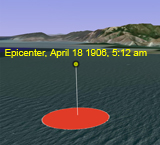
Origin Fourth dimension and Epicenter
At 5:12 AM local time, on April eighteen, 1906, a foreshock occurred with sufficient force to be felt widely throughout the San Francisco Bay area. The great convulsion bankrupt loose some twenty to 25 seconds after, with an epicenter in the Pacific Ocean just 2 miles due west of San Francisco. Within xxx seconds of the start of the main rupture, very potent shaking had swept throughout the unabridged San Francisco Bay Area, and lasted some 45 to 60 seconds. To larn more than virtually the epicenter see Location of the 1906 Focal region.
Origin Time and Epicenter (7 kB)
-
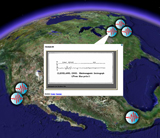
Seismograms
The earthquake was felt from southern Oregon to south of Los Angeles and inland as far as primal Nevada, an area of approximately 200,000 square miles, nearly viii times greater than that of the 1989 Hill Prieta convulsion (magnitude half-dozen.9). The ground move propagating away from the earthquake source is recorded past instruments called seismographs. The zigzag trace made by a seismograph, called a "seismogram," reflects the changing amplitude and frequency content of the ground shaking beneath the instrument. From seismograms, scientists can determine the time, the epicenter, the depth, and the type of faulting of an earthquake also equally estimate how much energy was released by it. Although there were but 5 seismographs in the Bay Area in 1906, the earthquake was recorded at a full of 96 stations effectually the earth.Bay Area seismograms are variable and highly complex mainly considering the shaking was so intense and the instruments were not sufficiently damped.
Seismograms(36 kB)
-
Rupture Length and Slip
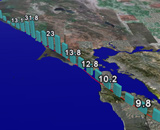
The 1906 convulsion ruptured the northernmost 296 miles (477 km) of the San Andreas Fault betwixt San Juan Bautista and Cape Mendocino. By comparing, the 1989 Loma Prieta convulsion had a rupture length of merely 25 miles. The San Andreas fault today has locked and creeping segments along its approximately 800 mile (1300 km) length in California. The 1906 earthquake ruptured all locked segments of the fault in northern California. The amount of horizontal sideslip, or relative movement along the mistake, varied from two to 32 feet (0.5 chiliad to 9.7 m). To better visualize this, picture continuing face to confront with a person on the opposite side of the fault and watching them slide horizontally 32 feet to your correct! The following file depicts the 1906 rupture length and the horizontal slip (in feet) forth the rupture as a histogram. Scientists now believe that details in the geology along the earthquake mistake plane, and differences in stress levels, may contribute to these changes in the amount of slip forth the fault.
Rupture Length and Sideslip(173 kB)
-
Tour of the Rupture
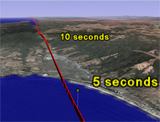
Earthquake ruptures travel at astounding speeds. Seismologists have estimated the average speed of the 1906 rupture along the San Andreas Fault to the north of the epicenter to exist eight,300 mi/hour (3.7 km/sec), and half-dozen,300 mi/hour (ii.8 km/sec) to the due south. By comparing, a Boeing 747 jet cruises at only 550 mi/hour. The following rupture tour shows how fast the rupture traveled northward from the 1906 epicenter. To view more sophisticated simulations of the rupture and strong footing shaking produced by the 1906 earthquake, see models that recreate the 1906 Ground Motions Simulations.
Tour the rupture, so click the new layer "1906 Northern Rupture Bout" in the left panel and follow the instructions to play the tour. Or you tin fly forth the northern role of the rupture at 8300 miles/hour to appreciate the actual speed of the rupture (viii Mb).
Bout of the Rupture (24 kB)
-
Shaking Intensity
Earthquake ruptures travel at phenomenal speeds. Seismologists have estimated the boilerplate speed of the 1906 rupture along the San Andreas Fault to the northward of the epicenter to be viii,300 mi/60 minutes (3.7 km/sec), and half dozen,300 mi/hour (2.8 km/sec) to the s. Past comparison, a Boeing 747 jet cruises at only 550 mi/hour. The post-obit rupture bout shows how fast the rupture traveled north from the 1906 epicenter. To view more sophisticated simulations of the rupture and strong ground shaking produced by the 1906 convulsion, meet models that recreate the 1906 Ground Motions Simulations.
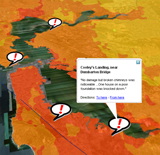
Well-nigh convulsion damage results from strong shaking. Damage caused past error rupture, landslides, and basis failure typically accounts for but a small fraction of the full damage from earthquakes. The 1906 earthquake is remembered mainly for the fire damage in San Francisco, yet in nearly places throughout northern California shaking damage dominated. The intensity of shaking that an area experiences during an earthquake depends on the magnitude of the earthquake, its distance from the fault, and the type of ground materials. Soft, h2o saturated sands and sediments amplify the shaking even at great distances from an earthquake, while boulder shakes to a much bottom extent. USGS geologists take produced a detailed map of shaking intensity that occurred during the 1906 earthquake, using historic accounts. The following file contains the 1906 "ShakeMap" and actual quotes from some of the historic accounts used to create information technology. For more information, see the 1906 Intensity Maps.
Shaking Intensity (644 kB)
Historic Photographs of the 1906 Earthquake »
Source: https://earthquake.usgs.gov/earthquakes/events/1906calif/virtualtour/earthquake.php

Post a Comment for "What areas are affected in the fault ruptures from north to south?"